Unit III: Aggregate Supply
Aggregate supply (AS): is the level of real GDP that firms will produce at each price level.
Ways to measure:

Ways to measure:
Long-run is the period of time where input prices are completely flexible and adjust to changes in the price level. In the long-run, the level of real GDP supplied is independent of the price level.
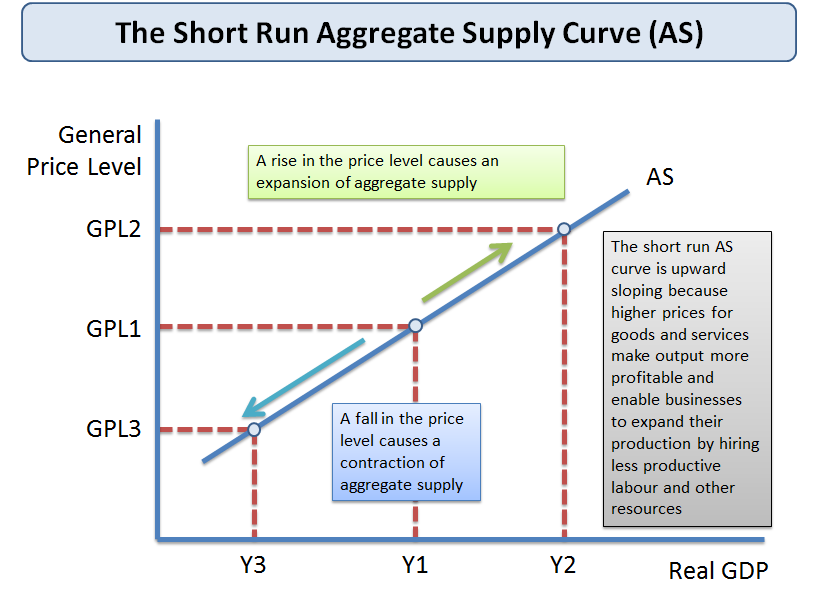
Short-run is the period of time where input prices are sticky and don't adjust to changes in the price level. In the short-run, the level of real GDP supplied is directly related to the price level.
There are two types: long-run aggregate supply (LRAS) and short-run aggregate supply (SRAS).
Long-run aggregate supply (LRAS):
- The long-run aggregate supply (LRAS) marks the level of full employment in the economy (analogous to production possibilities chart, or PPC).
- Because input prices are completely flexible in the long-run, changes in price level don't change firms' real profits and therefore don't change firms' level of output. This means that the LRAS is vertical at the economy's level of full employment.
- can be written as YF,FE,Y'
Short-run aggregate supply (SRAS) happens because input prices are sticky in the short-run, which means the SRAS is upward sloping.
Shifts in SRAS:
- An increase in SRAS is seen as a shift to the right (SRAS ->)
- A decrease in SRAS is seen as a shift to the left (SRAS <-)
The key to understanding shifts in SRAS is the per-unit cost of production. Its equation is as follows: per unit production cost = (total input cost)/(total output)
There are 3 determinants for SRAS (all of them affect per unit production cost): input or resource prices, productivity, and legal-institutional environment.
There are three categories for input/resource prices:
- Domestic resource prices
- wages (75% of all business costs)
- cost of capital
- raw materials (commodity prices)
- Foreign resource prices
- strong dollar (appreciation) = lower foreign resource prices
- weak dollar (depreciation) = higher foreign resource prices
- Market power
- monopolies and cartels that control resources and control the price of those resources
- OPEC is an example
- Increases in resource prices = SRAS shift left
- Decreases in resource prices = SRAS shift right
Productivity = (total output)/(total input)
- More productivity = lower unit production cost = SRAS shift right
- Lower productivity = higher unit production cost = SRAS shift left
There are two different parts of the legal-institutional environment:
- Taxes and subsidies
- taxes, which is money the government receives, on businesses increase per-unit production cost = SRAS shift left
- subsidies, which is money the government gives, to businesses reduce per-unit production cost = SRAS shift right
- Government regulation
- government regulation creates a cost of compliance = SRAS shift left
- deregulation reduces compliance costs = SRAS shift right
Comments
Post a Comment